
If you’ve been managing depression for any length of time, you’ve almost certainly been offered an antidepressant. Many people find them helpful. Many others find they work partially, stop working, or come with side effects that make sustained use difficult. And some people try two, three, or four different medications without achieving the relief they were hoping for.
If you’re in that second or third group, you may have started asking a different question: is there another way?
TMS is one answer to that question. It’s not simply a substitute for medication — it works differently, targets a different part of the problem, and suits a different clinical profile. Understanding the distinction helps you have a more informed conversation with your doctor and make a decision that’s based on your actual situation.
How Antidepressants Work
Antidepressants act on the brain’s chemical architecture. Most commonly, they work by increasing the availability of neurotransmitters — primarily serotonin, noradrenaline, or dopamine — in the synaptic gaps between neurons. The theory is that depression involves a deficiency or dysregulation in these chemical signals, and that correcting that imbalance restores mood.
For many people, this is accurate enough to produce meaningful improvement. SSRIs and SNRIs are effective, well-studied, and for a significant proportion of patients, they work.
How long do antidepressants take to work?
Most antidepressants take four to six weeks before producing a meaningful response — and in some cases up to twelve weeks for the full effect to become apparent. This delay is one of the more difficult aspects of medication management. You’re asked to tolerate side effects in the early weeks, often before any benefit is felt, on the basis that improvement may come later. For some patients, it does. For others, the medication never delivers what was hoped for, and the process begins again with a different drug.
Why do antidepressants cause weight gain, sexual side effects, and emotional blunting?

Because antidepressants work systemically — meaning they affect the entire body, not just the brain regions involved in mood. Serotonin receptors exist throughout the body, including in the gut, the cardiovascular system, and the tissues involved in sexual function. When you increase serotonin availability across the whole system, you get mood effects, but you also get effects elsewhere.
This is worth understanding clearly: these are not signs that the medication is working poorly. They are a predictable consequence of how it works. The systemic mechanism that produces the therapeutic effect is the same one that produces the side effects. Weight gain, sexual dysfunction, emotional blunting, sleep disruption, and gastrointestinal symptoms are common enough that many patients reduce their dose, switch medications, or stop altogether — sometimes without telling their doctor, because the conversation feels difficult.
What happens when antidepressants stop working?
This is more common than many patients realise. Some people experience a gradual reduction in effectiveness after a period of good response — the medication hasn’t changed, but the brain’s adaptation to it has. In these cases, doses are often increased, a second medication is added, or a switch is made to a different drug.
The limitations of medication become most apparent in three situations.
The first is partial response — the medication takes the edge off but doesn’t restore full function. The person is better, but not well. This is perhaps the most underacknowledged experience in depression treatment: functional enough to keep going, but not genuinely recovered. Many patients in this position stay on medication for years without ever asking whether something more complete is possible.
The second is side effects that make sustained use genuinely difficult. The calculus many patients face is uncomfortable: accept side effects that affect quality of life in order to maintain a partial improvement in mood. Neither option feels good, and many people endure this compromise far longer than they need to.
The third is treatment resistance.
What is treatment-resistant depression?

Treatment-resistant depression means depression that hasn’t responded adequately to standard medication approaches. Clinically, it’s defined as failing to achieve adequate remission after two or more antidepressants trialled at therapeutic doses for sufficient duration. Approximately one in three people with major depressive disorder fall into this category — and if you’re reading this, there’s a reasonable chance you’re one of them.
In treatment-resistant cases, adding another antidepressant — or switching to a different one — has a progressively lower likelihood of producing remission. Each failed trial reduces the probability of response to the next. This is the point at which a different approach becomes not just reasonable but clinically indicated.
Is it safe to stay on antidepressants long term?
For many people, long-term use is considered appropriate and is managed safely under medical supervision. The concern isn’t primarily toxicity — most antidepressants have a reasonable long-term safety profile. The more common issue is that long-term use is often continued not because it’s producing ongoing benefit, but because stopping feels difficult or risky, or because no one has revisited whether a better option now exists. If you’ve been on antidepressants for years and haven’t had a genuine conversation with your doctor about whether your current treatment is still the right one, that conversation is worth having.
How TMS Works
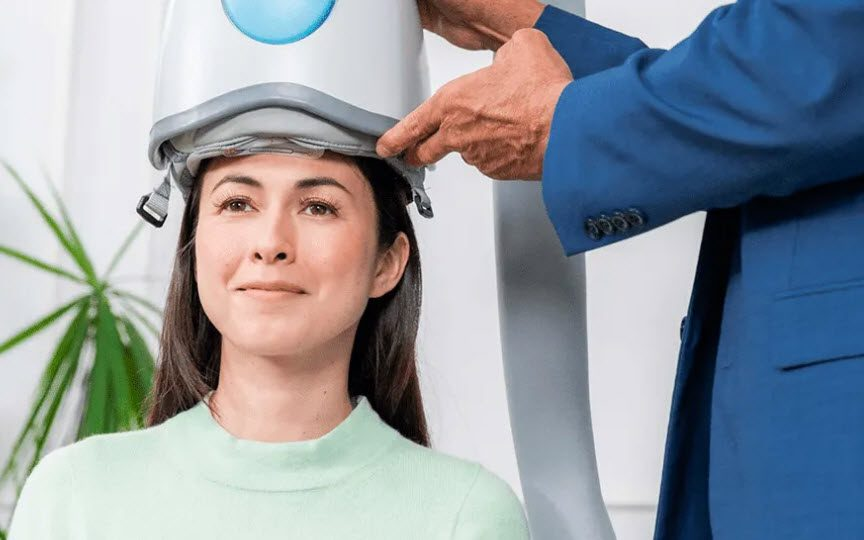
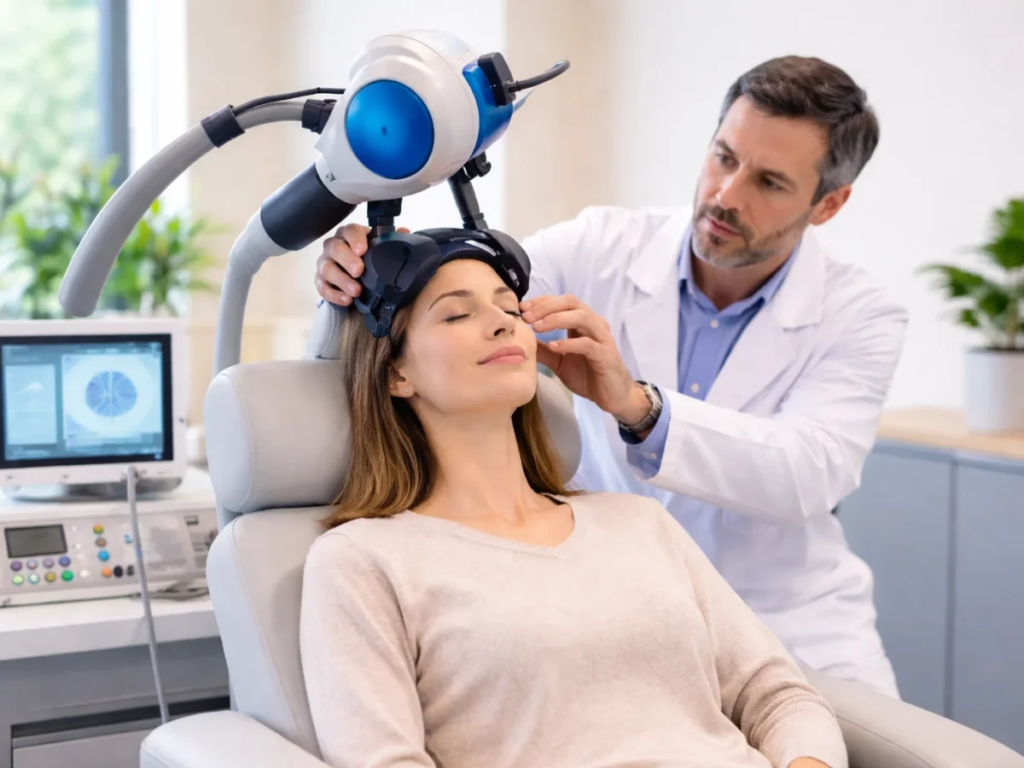
TMS operates on the brain’s electrical architecture rather than its chemical one. It uses precisely targeted magnetic pulses to modulate neural activity in specific cortical regions — primarily the dorsolateral prefrontal cortex (DLPFC), an area consistently implicated in mood regulation, emotional processing, and executive function.
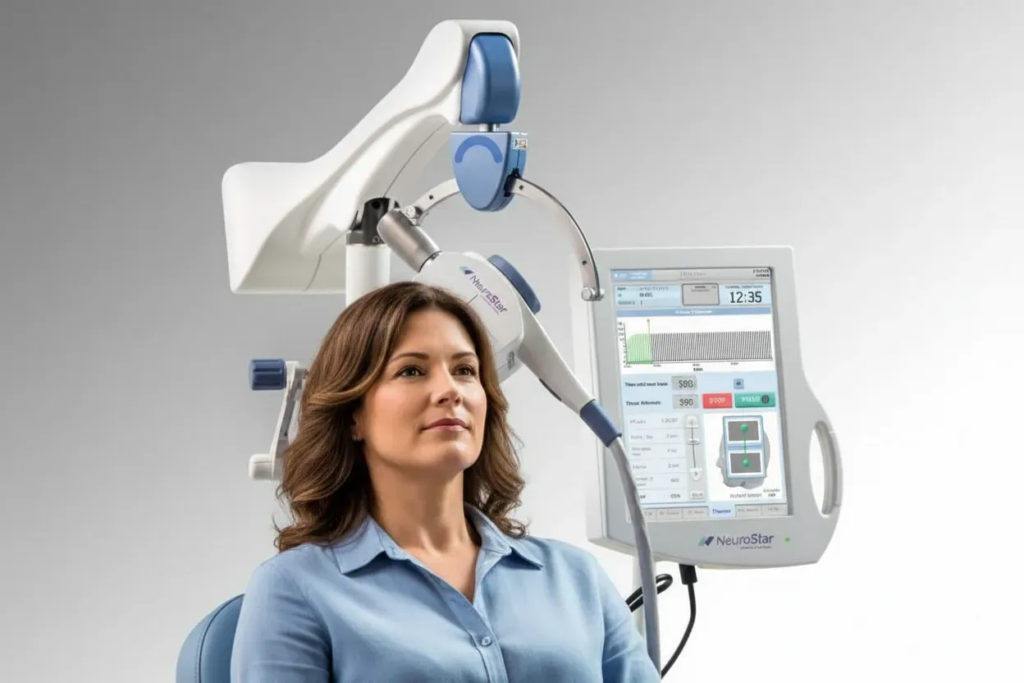
In depression, activity in the left DLPFC is typically reduced. TMS applies repetitive stimulation to this region, gradually increasing its activity and, over a full treatment course, producing changes in the neural circuits that regulate mood.
The TMS effect is not a drug effect: there is nothing entering your bloodstream. The mechanism is direct modulation of the brain’s electrical signalling — the same system that drives thought, emotion, and behaviour — rather than an indirect chemical influence on it.
The practical consequence of this distinction is significant:
- No systemic side effects. TMS does not affect your liver, your weight, your libido, or your sleep architecture.
- No sedation. You attend a session and leave. You can drive, work, and function normally throughout a treatment course.
- No interaction with existing medications. TMS can be used alongside antidepressants, not only instead of them.
What the Evidence Says
TMS holds TGA approval in Australia for major depressive disorder, and its evidence base spans decades of controlled clinical trials.
Response rates in treatment-resistant depression — patients who have already failed antidepressant treatment — sit at approximately 50 to 60 per cent for meaningful clinical improvement, with remission rates in the 30 to 35 per cent range. These figures are substantially better than the likelihood of achieving remission with a further antidepressant trial in the same population.
For patients who have not yet tried medication, TMS is generally not the first recommendation — antidepressants remain a well-supported first-line option. But for patients who have tried medication without adequate response, or who cannot tolerate medication, TMS represents a meaningful clinical step with a strong evidence base behind it.
Key Differences at a Glance
| Antidepressants | TMS | |
|---|---|---|
|
Mechanism |
Chemical — increases neurotransmitter availability |
Electrical — directly modulates neural activity |
|
Administration |
Daily oral medication at home
|
Clinic-based sessions, 5 days/week for 6–7 weeks
|
|
Side effects
|
Systemic — weight, sleep, sexual function, mood, GI
|
Local — mild scalp discomfort early on, no systemic effects
|
|
Time to effect
|
4–6 weeks
|
Variable — some notice change in weeks 2–3
|
|
Ongoing use
|
Often continued indefinitely
|
Defined course; maintenance available if needed
|
|
Best suited for
|
First-line treatment for most presentations
|
Where medication hasn’t worked or isn’t tolerated
|
Do I Have to Stay on Antidepressants While Doing TMS?
Not necessarily. Many patients complete a TMS course while remaining on their current medication, and there is good evidence that combining TMS with existing antidepressants can produce better outcomes than either alone. But TMS can also be used by patients who are not on medication, or who are in the process of tapering. This is something to discuss with your treating clinician based on your specific history.
Can TMS Reduce My Need for Antidepressants?
This is one of the most common questions we hear, and it’s a reasonable one. TMS does not come with a guarantee of medication reduction — and we wouldn’t claim otherwise. What it does offer is a treatment with a meaningfully different mechanism of action and a different side effect profile, which for some patients produces sufficient improvement that their prescribing doctor is able to reconsider their medication load. Whether that applies in your case depends on your response to treatment and is a conversation to have with your psychiatrist or GP as your TMS course progresses.
Can TMS Work If I've Been on Antidepressants for a Long Time?
Yes. Long-term antidepressant use does not reduce TMS effectiveness. The two treatments operate through entirely different mechanisms, and the brain’s response to TMS stimulation is not diminished by prior or current medication use.
What Are the Alternatives to Antidepressants for Depression?
TMS is one of the most evidence-based alternatives for people who haven’t responded adequately to medication. Others include structured psychotherapy (particularly CBT), ketamine or esketamine treatment, and in severe cases, electroconvulsive therapy (ECT). TMS sits in a useful middle ground: more targeted than medication, less intensive than ECT, and with a side effect profile that most patients find significantly more manageable than their medication experience.
Can You Do Both?
Yes — and many patients do. TMS and antidepressants are not mutually exclusive. There is good evidence that combining TMS with existing medication can produce better outcomes than either alone, and clinical practice at our clinic routinely involves patients who remain on their current medication while completing a TMS course.
The goal is not to replace one with the other. It is to address the parts of the problem that each treatment is best positioned to reach.
So Which Is Right for You?

That depends on your clinical history, your current treatment trajectory, and what you’re trying to achieve.
If you haven’t yet tried antidepressants, medication is likely your first conversation with your GP or psychiatrist — and rightly so.
If you’ve tried medication and it hasn’t worked as well as you needed it to, or if side effects have made sustained use difficult, TMS is a clinically appropriate next step with a strong evidence base and a meaningfully different mechanism of action.
If you’re not sure, the most useful thing you can do is ask your GP to refer you for an initial assessment at our clinic. That appointment is a clinical conversation — not a commitment to treatment — and it gives you the information you need to make a decision that’s right for your situation.
Disclaimer
This information is provided for general educational and research purposes only and does not constitute medical advice, diagnosis, or treatment recommendations. It is not a substitute for professional clinical judgement or personalised care. Patients with any concerns about their health or treatment options should discuss them directly with their treating psychiatrist or qualified healthcare professional, who can provide individualised assessment and advice in accordance with current evidence-based practice, AHPRA standards, Therapeutic Goods Administration (TGA) requirements, and relevant guidelines from bodies such as the Royal Australian and New Zealand College of Psychiatrists (RANZCP). Brain Aid Clinics strongly recommends seeking professional medical evaluation for your specific circumstances before commencing, modifying, or discontinuing any treatment. Individual results may vary, and no outcomes are guaranteed.

Melbourne Clinic
8 Fullarton Dr, Epping VIC 3076, Australia
Gold Coast Clinic
level 2/151 Smith St, Southport QLD 4215, Australia