

This is one of the most common questions we receive from physiotherapists, occupational therapists, and the injured workers they support: can WorkCover fund TMS therapy for chronic pain?
The honest answer is: it depends.
Brain Aid Clinics has direct experience navigating that process.
This article is for both injured workers exploring their options and the allied health professionals supporting their recovery. It explains what TMS is, what the clinical evidence says about its use in chronic pain, how WorkCover funding decisions are made, and what the process of submitting an application looks like.
What Is TMS and Why Is It Relevant to Chronic Pain?
Transcranial Magnetic Stimulation (TMS) is a non-invasive brain stimulation therapy that uses targeted magnetic pulses to modulate neural activity in specific cortical regions. It is best known as a treatment for depression, where it holds TGA approval in Australia. But its clinical application is broader than that.
Chronic pain — particularly neuropathic pain, fibromyalgia, and complex regional pain syndrome (CRPS) — is not purely a peripheral tissue problem. It involves central sensitisation: a state in which the brain’s pain-processing circuits become dysregulated, amplifying and sustaining pain signals beyond what the original injury would explain. This is precisely the domain in which TMS operates.
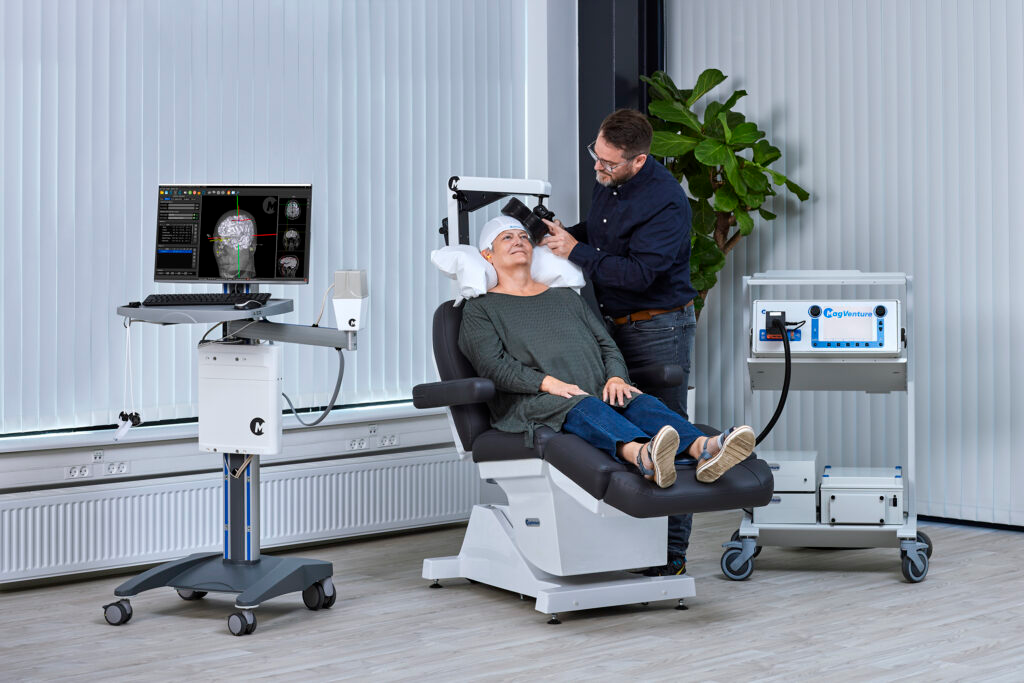
By targeting the primary motor cortex (M1) and prefrontal regions involved in pain modulation, rTMS can “turn down the volume” on central pain processing — not by masking symptoms pharmacologically, but by modulating the underlying neural architecture that maintains the pain state.
The evidence base is growing. Studies have demonstrated meaningful pain reduction with rTMS in patients with neuropathic pain, fibromyalgia, and CRPS — populations that frequently exhaust conventional pharmacological and procedural options without achieving adequate relief. A 2025 international randomised controlled trial published in the *British Journal of Anaesthesia* assessed motor cortex rTMS as an add-on therapy in fibromyalgia, adding to a substantial body of controlled trial data across chronic pain conditions.
TMS is also well-suited to the complexity of work injury presentations, where chronic pain frequently coexists with depression, anxiety, and PTSD — all conditions for which TMS has an established clinical role.
How WorkCover Funding Decisions Are Made
WorkCover and workers’ compensation schemes in Australia do not have a fixed list of approved and excluded treatments. Funding decisions are made on a case-by-case basis, guided by medical evidence and the individual’s clinical circumstances.
The relevant questions a case manager or insurer will typically consider include:
– Is there a documented work-related injury or condition?
– Has the treatment been recommended by a treating medical practitioner?
– Is there clinical evidence supporting the proposed treatment for this presentation?
– Have conventional treatments been adequately trialled without achieving sufficient improvement?
– Is the proposed treatment likely to support recovery and return to function?
TMS can satisfy each of these criteria in the right clinical context. It is not experimental for the conditions listed above — there is a substantial peer-reviewed evidence base, and it has been approved by WorkCover schemes for eligible patients in Australia.
Brain Aid Clinics has experience preparing documentation for WorkCover submissions and has had TMS treatment approved for patients under workers’ compensation. We understand what case managers need to see, and we work with the patient’s treating team to provide that clearly.
Which Presentations Are Most Likely to Be Considered
While no outcome can be guaranteed in advance, WorkCover submissions for TMS are most likely to receive serious consideration where:

Chronic neuropathic pain is the primary or contributing presentation — including nerve injury pain following workplace trauma, post-surgical neuropathic pain, or central sensitisation following a physical injury.
Complex regional pain syndrome (CRPS) — a condition that is frequently refractory to standard treatment and where the central nervous system plays a prominent mechanistic role. The absence of adequate conventional treatment options strengthens the case for an evidence-based neuromodulation approach.
Fibromyalgia or widespread central sensitisation — particularly where the injury context has been a precipitating or aggravating factor and where medication trials, physiotherapy, and psychological intervention have not achieved functional restoration.
Comorbid depression or PTSD alongside chronic pain — a common presentation in work injury cases, and one where TMS addresses both the psychological and pain dimensions within a single treatment course.
The clinical picture matters. A presentation where TMS targets multiple aspects of a complex injury — rather than a single isolated symptom — is easier to support in a funding submission.
What the Process Looks Like
Step 1: Clinical assessment
The treating physiotherapist, GP, or specialist refers the patient to Brain Aid Clinics for an initial clinical assessment. This is not a commitment to treatment — it is an evaluation of suitability. Our Medical Director reviews the patient’s history, current treatment trajectory, and whether TMS is clinically indicated.
Step 2: Supporting documentation
Where TMS is clinically indicated, Brain Aid Clinics prepares the documentation required to support a WorkCover funding application. This includes a clinical justification letter, relevant evidence citations, the proposed treatment protocol, and anticipated outcomes. We work with the referring team to ensure the submission is comprehensive.
Step 3: Case manager review
The application is submitted to the case manager or insurer for review. This process involves their internal medical advisors and varies in timeframe depending on the scheme and claim complexity. We are available to respond to queries from the insurer during this review period.
Step 4: Treatment commencement
Where funding is approved, treatment commences. Progress is monitored using validated clinical measures throughout the course, and reports are provided to the case manager at agreed intervals.
For Referring Physiotherapists and Allied Health Professionals

If you are supporting a patient with a work injury and chronic pain that has not adequately responded to physiotherapy, medication, or psychological intervention, TMS is worth raising as a next step.
A referral to Brain Aid Clinics for an initial assessment does not commit the patient to treatment or the insurer to funding. It begins a clinical conversation with a team that understands the WorkCover process, has successfully navigated it, and can provide the documentation required to give a funding application the strongest possible basis.
We welcome direct contact from treating physios and allied health professionals to discuss specific cases before referral.
Getting Started
For injured workers: speak with your GP, physiotherapist, or specialist about whether TMS may be appropriate for your presentation, and ask for a referral to Brain Aid Clinics for an assessment.
For treating practitioners: contact Brain Aid Clinics directly to discuss your patient’s presentation before making a referral. We can advise on clinical suitability and the WorkCover submission process at that point.
Visit: brainaidclinics.com.au or contact your nearest clinic — Gold Coast (Southport) or Melbourne (Epping).
Brain Aid Clinics is a precision neuronavigated rTMS clinical network operating across Australia. Our clinical framework is grounded in Kindness, Accuracy and Precision, Respect, and Evidence and Ongoing Education (KARE). All treatment decisions are made on an individual basis following thorough clinical assessment.
Disclaimer
This information is provided for general educational and research purposes only and does not constitute medical advice, diagnosis, or treatment recommendations. It is not a substitute for professional clinical judgement or personalised care. Patients with any concerns about their health or treatment options should discuss them directly with their treating psychiatrist or qualified healthcare professional, who can provide individualised assessment and advice in accordance with current evidence-based practice, AHPRA standards, Therapeutic Goods Administration (TGA) requirements, and relevant guidelines from bodies such as the Royal Australian and New Zealand College of Psychiatrists (RANZCP). Brain Aid Clinics strongly recommends seeking professional medical evaluation for your specific circumstances before commencing, modifying, or discontinuing any treatment. Individual results may vary, and no outcomes are guaranteed.
Frequently Asked Questions
Lifestyle strategies can support general wellbeing and help with day-to-day functioning. They are not considered a standalone treatment for depression. For many people, clinical care is an important part of the picture.
Reduced energy, low motivation, and difficulty concentrating are commonly reported experiences during periods of low mood. These can affect even routine tasks — and are not a reflection of effort or character.
In most cases, that approach isn’t sustainable. Focusing on one small, manageable step tends to be more practical — and more effective over time.
Yes. Lifestyle strategies are often part of a broader care approach, used alongside clinical support to help maintain structure and general health.
If you’ve tried approaches that haven’t delivered sufficient benefit, specialist assessment may help clarify what else might be appropriate for your situation. A clinician can help you understand what options exist and whether they’re suitable for you.
If symptoms are ongoing, worsening, or affecting your ability to function day to day, a professional assessment is a reasonable next step. You don’t need to wait for things to get significantly worse before reaching out.