
How Breathing Techniques Can Help Calm the Nervous System
If you have been living with depression and have not had the response you hoped for from antidepressant medication or psychological therapy, it can be difficult to know what to consider next. You may have come across the term transcranial magnetic stimulation (TMS).
TMS is a non-invasive form of brain stimulation. When it is delivered as a repeated course of treatment for depression, it is referred to as repetitive transcranial magnetic stimulation (rTMS), and it has been available with a Medicare rebate in Australia since November 2021 for people who meet specific clinical criteria.
This guide explains what rTMS is, what the evidence does and does not show, what a course of treatment involves, and how to work out — with your treating team — whether it is a reasonable option for you.
This article is general information only. It is not a substitute for individual medical advice. Whether rTMS is appropriate for you is a decision for you and your treating practitioners, based on your full history.
What Is Transcranial Magnetic Stimulation, and How Does It Work?
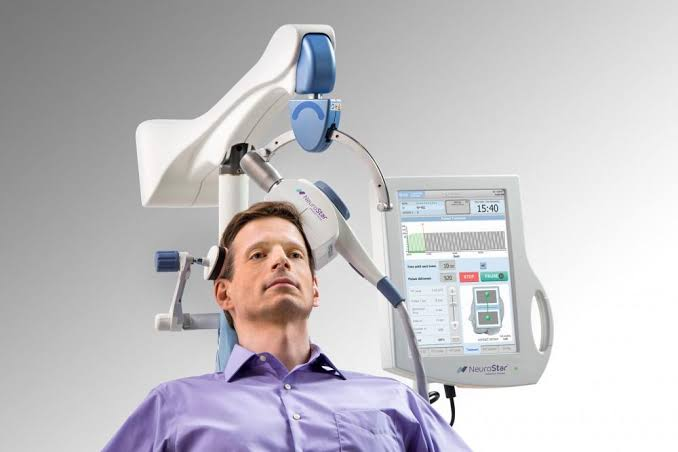
Instead of circulating through your entire body like a daily medication, TMS (Transcranial Magnetic Stimulation) works on the brain directly. TMS uses a magnetic field, generated by a coil held against the scalp, to induce a small electrical current in a targeted region of the cerebral cortex. Delivered repeatedly over a course of sessions, this is intended to modulate activity in brain networks involved in mood regulation.
Focused Magnetic Pulses ➔ Targets Mood Center (DLPFC) ➔ Gentle Stimulation of Brain Networks
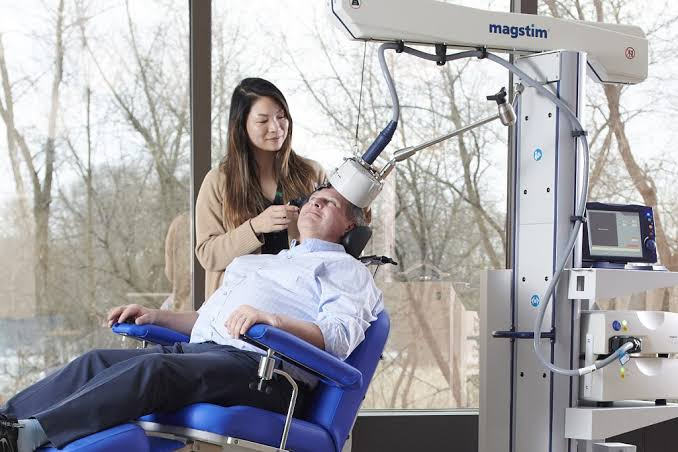
Here is what is actually happening behind the scenes:
- Targeted Care: A magnetic coil is placed against your scalp to deliver mild magnetic pulses—similar to the technology used in an MRI machine.
- Waking Up Inactive Networks: These pulses gently stimulate specific, underactive pathways in the brain (like the dorsolateral prefrontal cortex) that regulate mood, motivation, and energy.
- A Different Pathway: Because TMS is localised rather than systemic, it avoids common medication side effects like weight gain, nausea, or brain fog.
The Science Behind the Treatment
The cortical target. The most established target for depression is the dorsolateral prefrontal cortex (DLPFC). Neuroimaging research has consistently implicated prefrontal regions, including the DLPFC, among the areas showing altered activity in major depressive disorder, with some of these changes shifting following treatment (Fitzgerald et al., 2008). The relationship is more complex than a single “underactive” region, and research into targeting continues.
Electromagnetic induction. A treatment coil is positioned against the scalp and delivers brief magnetic pulses. The peak field strength is broadly comparable to that of a clinical MRI scanner, though the field is pulsed and focal rather than continuous and whole-body.
Effects on brain activity. Repeated stimulation is thought to alter cortical excitability and connectivity in the stimulated network, mechanisms often described in the literature under the broad heading of neuroplasticity. The precise mechanism by which rTMS improves depressive symptoms is not fully established, and this remains an active area of research (Lefaucheur et al., 2020).
What Is rTMS Used to Treat?
Research into rTMS spans a wide range of neurological and psychiatric conditions. The evidence is far stronger for some than for others, and it is worth being clear about the difference.

Major Depressive Disorder
Depression is the indication with the strongest evidence base and the only indication for which rTMS currently attracts a Medicare rebate in Australia. European evidence-based guidelines assign their highest evidence rating (Level A, definite efficacy) to high-frequency rTMS of the left DLPFC for depression (Lefaucheur et al., 2020). This is supported by multi-site randomised sham-controlled trials (O’Reardon et al., 2007; George et al., 2010) and by later large randomised trials comparing stimulation protocols (Blumberger et al., 2018).
It is equally important to be clear that rTMS does not work for everyone. In published trials, a meaningful proportion of participants did not respond, and outcomes vary considerably between individuals. Nobody can predict in advance how you will respond. If you would like to discuss what the trial data show, and what they mean for someone with your particular history, that is a conversation to have at your assessment.
Anxiety Symptoms Occurring Alongside Depression
Depression and anxiety frequently occur together. Some studies have reported that anxiety symptoms improve alongside depressive symptoms during a course of rTMS delivered for depression.
However, the evidence for rTMS as a treatment for anxiety disorders in their own right is preliminary, and evidence-based guidelines have not reached a definite efficacy rating for these conditions (Lefaucheur et al., 2020). Anxiety is not a Medicare-rebated indication for rTMS in Australia. We mention it here for completeness, not as a treatment offer.
Who May Be Eligible for Medicare-Rebated rTMS?
Medicare eligibility for an initial course of rTMS is set out under MBS item 14216 and is tightly defined. To be eligible, a person must:
- be at least 18 years old;
- be diagnosed with a major depressive episode;
- not have previously received transcranial magnetic stimulation therapy in any public or private setting;
- have failed to achieve satisfactory improvement despite adequate trials of at least two different classes of antidepressant medication (unless contraindicated), with adherence formally assessed, each medication trialled at the recommended therapeutic dose for a minimum of three weeks, and titrated to the maximum tolerated dose where clinically appropriate; and
- have undertaken psychological therapy, where clinically appropriate.
An initial course covers up to 35 treatment sessions. A retreatment course, under separate items, covers up to 15 sessions.
Two points that are often misunderstood:
- A GP referral starts the process, but does not by itself establish eligibility. Referral for item 14216 should come from a GP or a psychiatrist. Eligibility is then assessed and documented by the psychiatrist.
- Prescription and treatment mapping must be personally performed by a psychiatrist who has completed recognised rTMS training. Treatment sessions may be delivered by that psychiatrist or by a trained health professional working on their behalf, with the psychiatrist remaining responsible for treatment planning and monitoring.
A Medicare rebate does not necessarily mean there is no cost to you. Ask us for a written estimate of fees and any out-of-pocket amount before you commit to a course.
Safety, Side Effects and Contraindications
rTMS is generally well tolerated, but it is a medical procedure with real risks, and you are entitled to a complete picture before deciding.

Common side effects
- Discomfort or pain at the stimulation site during treatment
- Headache, usually mild, most often in the first week
- Facial or scalp muscle twitching during stimulation
- Transient light-headedness
These are typically mild and tend to settle as treatment continues. Simple analgesia is often sufficient for treatment-related headaches.
Uncommon and rare risks
- Seizure. This is the most serious potential risk of TMS. It is rare when established stimulation parameters and screening protocols are followed, but it is not zero, and the risk is higher in some people (Rossi et al., 2021). We screen for this at assessment.
- Syncope (fainting), which is more common than seizure and is usually a response to the situation rather than to the stimulation itself.
- Hearing effects. The device produces a loud clicking sound. Hearing protection is used during every session.
- Emergence of manic or hypomanic symptoms, reported rarely, particularly in people with a bipolar spectrum diagnosis.
- Worsening mood or suicidal thoughts. Depression can worsen during any treatment. Tell us immediately if this happens, and seek urgent help if you are unsafe.
Contraindications and cautions
rTMS is not suitable for everyone. Tell your practitioner if you have:
- Any ferromagnetic or electronic implant in or near the head — for example, an aneurysm clip or coil, cochlear implant, deep brain stimulator, or a ventriculoperitoneal shunt with metallic components. (Standard dental fillings and orthodontic braces are not a barrier.)
- Any implanted device that may be affected by magnetic fields, including a cardiac pacemaker or implantable defibrillator.
- A history of seizures or epilepsy, a family history of epilepsy, or any condition affecting the brain such as prior stroke, brain injury or intracranial surgery.
- Any medication that may lower the seizure threshold, and any recent change to it. Bring a full list, including anything you have started or stopped recently.
- Significant alcohol use, sleep deprivation, or withdrawal from alcohol or sedatives.
- Pregnancy, or the possibility of pregnancy.
This list is a guide to the conversation, not a self-assessment tool. Full screening is part of your assessment.
What to Expect Across a Course of Treatment
rTMS is an outpatient procedure. You remain awake and alert throughout, and no anaesthesia or sedation is used.
Before treatment: assessment and mapping
Treatment begins with an assessment and a mapping session performed personally by an rTMS-trained psychiatrist. Mapping identifies the scalp position corresponding to your cortical target and establishes your individual motor threshold — the lowest stimulation intensity that produces a small movement in your hand. Treatment intensity is then set relative to your own threshold, so the dose is individualised rather than standard.
During treatment: the sessions
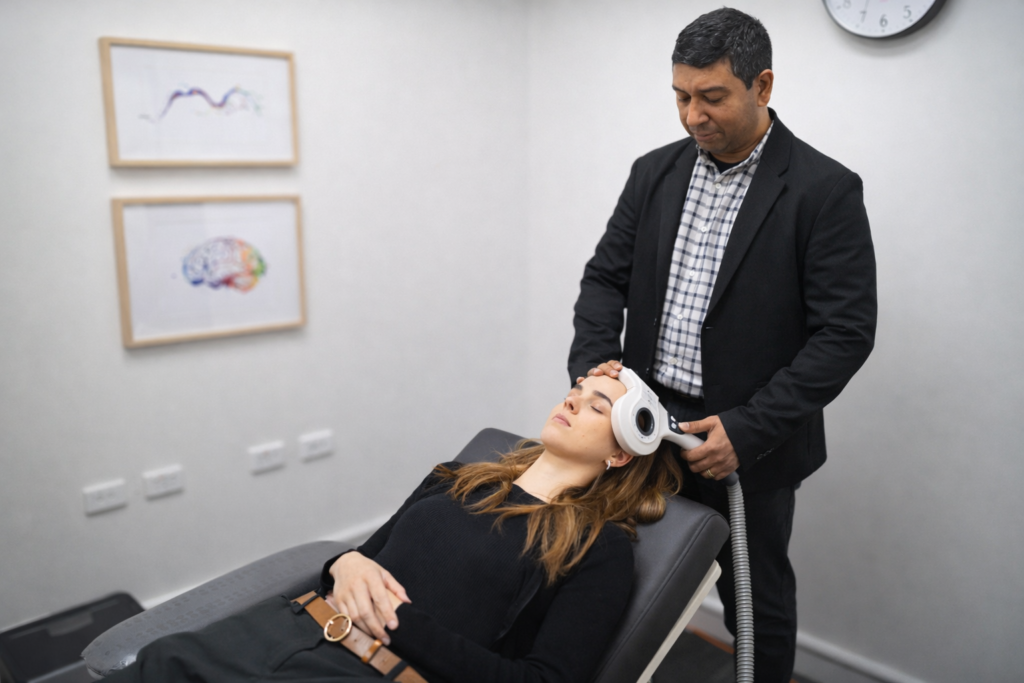
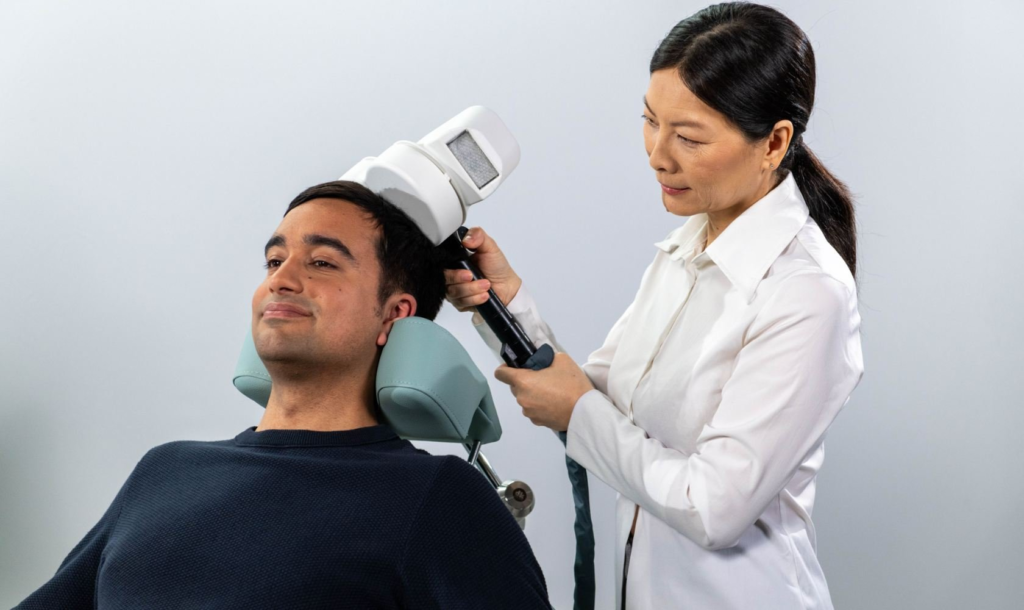
You sit in a treatment chair while the coil is positioned. The pulses feel and sound like a firm tapping against the scalp. Session length depends on the protocol prescribed for you and commonly ranges from a few minutes to around half an hour. Sessions are usually delivered on weekdays over several weeks.
Many people read, listen to music or talk with the clinician during treatment.
After treatment: the rest of your day
rTMS is not associated with the memory and cognitive side effects that can follow electroconvulsive therapy, and it does not require a recovery period in the way a sedated procedure does. Most people drive themselves home and return to their usual activities straight after a session. Your clinician will confirm what is appropriate for you, particularly after your first few sessions.
Response, when it occurs, is usually gradual rather than sudden. We track your symptoms with validated measures throughout the course so that progress — or lack of it — is visible to both of us, and so that the plan can be changed if it is not working.

Melbourne Clinic
8 Fullarton Dr, Epping VIC 3076, Australia
Gold Coast Clinic
level 2/151 Smith St, Southport QLD 4215, Australia
If You Need Support Right Now
If you are in immediate danger, call 000.
If you are struggling and need to talk to someone today:
Lifeline — 13 11 14 (24 hours)
13YARN — 13 92 76 (24 hours, for Aboriginal and Torres Strait Islander people)
Beyond Blue — 1300 22 4636 (24 hours)
Taking the Next Step
If you would like to find out whether rTMS may be appropriate for you:
- Talk to your GP or psychiatrist. Discuss whether rTMS is worth considering as part of your treatment plan, and ask them to prepare a referral together with a summary of your medication and treatment history. Having that history documented in advance makes the eligibility assessment considerably smoother.
- Complete our referral form. Your GP or psychiatrist can send it directly, or you can start the process and we will liaise with them.
- Attend your assessment. We review your history, complete safety screening, confirm whether you meet the Medicare criteria, and give you a written estimate of costs. If rTMS is not appropriate for you, we will tell you, and we will discuss what else may be worth considering.
References
Blumberger, D. M., Vila-Rodriguez, F., Thorpe, K. E., Feffer, K., Noda, Y., Giacobbe, P., Knyahnytska, Y., Kennedy, S. H., Lam, R. W., Daskalakis, Z. J., & Downar, J. (2018). Effectiveness of theta burst versus high-frequency repetitive transcranial magnetic stimulation in patients with depression (THREE-D): A randomised non-inferiority trial. The Lancet, 391(10131), 1683–1692. https://doi.org/10.1016/S0140-6736(18)30295-2
Fitzgerald, P. B., Laird, A. R., Maller, J., & Daskalakis, Z. J. (2008). A meta-analytic study of changes in brain activation in depression. Human Brain Mapping, 29(6), 683–695. https://doi.org/10.1002/hbm.20426
George, M. S., Lisanby, S. H., Avery, D., McDonald, W. M., Durkalski, V., Pavlicova, M., Anderson, B., Nahas, Z., Bulow, P., Zarkowski, P., Holtzheimer, P. E., 3rd, Schwartz, T., & Sackeim, H. A. (2010). Daily left prefrontal transcranial magnetic stimulation therapy for major depressive disorder: A sham-controlled randomized trial. Archives of General Psychiatry, 67(5), 507–516. https://doi.org/10.1001/archgenpsychiatry.2010.46
Lefaucheur, J. P., Aleman, A., Baeken, C., Benninger, D. H., Brunelin, J., Di Lazzaro, V., Filipović, S. R., Grefkes, C., Hasan, A., Hummel, F. C., Jääskeläinen, S. K., Langguth, B., Leocani, L., Londero, A., Nardone, R., Nguyen, J. P., Nyffeler, T., Oliveira-Maia, A. J., … Ziemann, U. (2020). Evidence-based guidelines on the therapeutic use of repetitive transcranial magnetic stimulation (rTMS): An update (2014–2018). Clinical Neurophysiology, 131(2), 474–528. https://doi.org/10.1016/j.clinph.2019.11.002
O’Reardon, J. P., Solvason, H. B., Janicak, P. G., Sampson, S., Isenberg, K. E., Nahas, Z., McDonald, W. M., Avery, D., Fitzgerald, P. B., Loo, C., Demitrack, M. A., George, M. S., & Sackeim, H. A. (2007). Efficacy and safety of transcranial magnetic stimulation in the acute treatment of major depression: A multisite randomized controlled trial. Biological Psychiatry, 62(11), 1208–1216. https://doi.org/10.1016/j.biopsych.2007.01.018
Rossi, S., Antal, A., Bestmann, S., Bikson, M., Brewer, C., Brockmöller, J., Carpenter, L. L., Cincotta, M., Chen, R., Daskalakis, J. D., Di Lazzaro, V., Fox, M. D., George, M. S., Gilbert, D., Kimiskidis, V. K., Koch, G., Ilmoniemi, R. J., Lefaucheur, J. P., … Hallett, M. (2021). Safety and recommendations for TMS use in healthy subjects and patient populations, with updates on training, ethical and regulatory issues: Expert guidelines. Clinical Neurophysiology, 132(1), 269–306. https://doi.org/10.1016/j.clinph.2020.10.003
Australian Government Department of Health and Aged Care. (2021). Medicare Benefits Schedule item 14216 and explanatory note TN.1.28 — Repetitive transcranial magnetic stimulation. MBS Online.